---
title: LamiPress: How LiSEC Expands Its Portfolio for Laminated Glass Production
description: LamiPress revolutioniert die Verbundglasfertigung mit einer hochpräzisen, flexiblen Lösung, die Ausschuss minimiert und Durchlaufzeiten verkürzt.
image: https://blog.lisec.com/hubfs/Lamipress_03_web.jpg
---
- [BLOG](https://blog.lisec.com/)
- [CONTACT](https://www.lisec.com/about-lisec/contact)
- [DOWNLOADS](https://www.lisec.com/news/downloads)
- [Hotline & ONLINESUPPORT](https://www.lisec.com/competence/after-sale-service/hotline-online-support)
- [SUCCESS STORIES](https://www.lisec.com/news/success-stories-1)
- [](https://www.lisec.com/contact/)
- [](https://business-portal.lisec.com/signin.php)
- 
### CHOOSE YOUR LANGUAGE
- [English](https://blog.lisec.com/lamipress)
- [Deutsch](https://blog.lisec.com/de/lamipress)
- SOLUTIONS
- Systems & Lines
- [Glass Cutting Line](https://www.lisec.com/solutions/systems-lines#collapse-42)
- [Insulating glass line](https://www.lisec.com/solutions/systems-lines#collapse-911)
- [Glass Processing Line](https://www.lisec.com/solutions/systems-lines#collapse-43)
- [Laminated Glass Line](https://www.lisec.com/solutions/systems-lines#collapse-199)
- [Individual Machines](https://www.lisec.com/solutions/individual-machines)
- [Glass Cutting](https://www.lisec.com/solutions/individual-machines#collapse-34)
- [Insulating Glass Production](https://www.lisec.com/solutions/individual-machines#collapse-34)
- [Sorting & Logistics Systems](https://www.lisec.com/solutions/individual-machines#collapse-44)
- [Flat Glass Processing](https://www.lisec.com/solutions/individual-machines#collapse-36)
- [Glass Processing & Wash](https://www.lisec.com/solutions/individual-machines#collapse-219)
- [Quality management](https://www.lisec.com/solutions/individual-machines#collapse-46)
- [Tempering](https://www.lisec.com/solutions/individual-machines#collapse-46)
- [base](https://www.lisec.com/solutions/individual-machines#collapse-38)
- [Success Stories](https://www.lisec.com/solutions/individual-machines#collapse-209)
- [Software](https://www.lisec.com/solutions/software)
- [Software for Business Management](https://www.lisec.com/solutions/software/#collapse-82)
- [Software for Production Management](https://www.lisec.com/solutions/software/#collapse-120)
- [Software for Shopfloor Management](https://www.lisec.com/solutions/software/#collapse-123)
- [Software on machines](https://www.lisec.com/solutions/software/#collapse-124)
- [Preowned machines](https://www.lisec.com/solutions/preowned-machines/)
- COMPETENCE
- [AFTER SALES / SERVICES](https://www.lisec.com/competence/after-sale-service/)
- [HOTLiNE & ONLiNE SUPPORT](https://www.lisec.com/competence/after-sale-service/hotline-online-support/)
- [LiSEC Process Control](https://www.lisec.com/competence/after-sale-service/lisec-process-control/)
- [Live Support System - LiSEC.eye](https://www.lisec.com/competence/after-sale-service/live-support-system-liseceye/)
- [LiSERV](https://www.lisec.com/competence/after-sale-service/liserv/)
- [My LiSEC](https://www.lisec.com/competence/after-sale-service/my-lisec/)
- [Spare Parts](https://www.lisec.com/competence/after-sale-service/spare-parts/)
- [LiSAIR Express Delivery](https://www.lisec.com/competence/after-sale-service/lisair-express-delivery/)
- [Contacts spare parts service](https://www.lisec.com/competence/after-sale-service/contacts-spare-parts-service/)
- [Inspection and Maintenance](https://www.lisec.com/competence/after-sale-service/inspection-and-maintenance/)
- [Installation](https://www.lisec.com/competence/after-sale-service/installation/)
- [LONGLiFE](https://www.lisec.com/competence/after-sale-service/longlife/)
- [Training](https://www.lisec.com/competence/after-sale-service/training/)
- [FAQ](https://www.lisec.com/competence/after-sale-service/faq/)
- [PROCESS DEVELOPMENT](https://www.lisec.com/competence/process-development/products)
- [Products](https://www.lisec.com/competence/process-development/products)
- [References](https://www.lisec.com/competence/process-development/references#?)
- [Contact](https://www.lisec.com/competence/process-development/contact/glastech-produktions-und-verfahrenstechnik-gmbh)
- [CE Declaration of Performance](https://www.lisec.com/competence/process-development/contact/glastech-produktions-und-verfahrenstechnik-gmbh)
- [GLASTECH](https://www.lisec.com/competence/process-development/glastech)
- [GLASTECH CERTIFICATE](https://www.lisec.com/footer/news/downloads/#?category=750&subcategory=751)
- [SPACER](https://www.lisec.com/footer/news/downloads/#?category=750&subcategory=751)
- [PRODUCTS](https://www.lisec.com/competence/spacer/products)
- CAREERS
- [Working At LiSEC](https://www.lisec.com/careers/working-at-lisec)
- [Apprenticship At LiSEC](https://www.lisec.com/careers/apprenticeship-at-lisec)
- [A Day At LiSEC](https://www.lisec.com/careers/a-day-at-lisec)
- [Online Application](https://lisec.bewerberportal.at/Jobs)
- [Carrer Fairs](https://www.lisec.com/careers/career-fairs)
- [Contact](https://www.lisec.com/careers/contact/austria/)
- NEWS
- [News](https://www.lisec.com/news/news)
- [Success Stories](https://www.lisec.com/news/success-stories-1)
- [Events](https://www.lisec.com/news/events/)
- [Press Contact](https://www.lisec.com/news/press-contact/)
- [Press Distributor](https://www.lisec.com/news/press-distributor/)
- [Downloads](https://www.lisec.com/footer/news/downloads/)
- ABOUT LISEC
- [Company](https://www.lisec.com/about-lisec/company/)
- [Management](https://www.lisec.com/about-lisec/management/)
- [History](https://www.lisec.com/about-lisec/history/)
- [Purchasing](https://www.lisec.com/about-lisec/purchasing)
- [Contact](https://www.lisec.com/about-lisec/contact)
[](https://www.lisec.com/)
- [Systems & Lines](https://www.lisec.com/de/loesungen/systemloesungen-linien/)
- [Glass Cutting Line](https://www.lisec.com/solutions/systems-lines/#collapse-42)
- [](https://www.lisec.com/solutions/systems-lines/#collapse-42)
- [Insulating glass line](https://www.lisec.com/solutions/systems-lines/#collapse-911)
- [](https://www.lisec.com/solutions/systems-lines/#collapse-911)
- [Glass Processing Line](https://www.lisec.com/solutions/systems-lines/#collapse-43)
- [](https://www.lisec.com/solutions/systems-lines/#collapse-43)
- [Laminated Glass Line](https://www.lisec.com/solutions/systems-lines/#collapse-199)
- 
- [Individual Machines](https://www.lisec.com/solutions/individual-machines)
- [Glass Cutting](https://www.lisec.com/solutions/individual-machines#collapse-34)
- [](https://www.lisec.com/solutions/stand-alone-machines/#collapse-34)
- [Insulating Glass Production](https://www.lisec.com/solutions/individual-machines#collapse-34)
- [](https://www.lisec.com/solutions/stand-alone-machines/#collapse-34)
- [Sorting & Logistics Systems](https://www.lisec.com/solutions/individual-machines#collapse-44)
- [](https://www.lisec.com/solutions/stand-alone-machines/#collapse-44)
- [Flat Glass Processing](https://www.lisec.com/solutions/individual-machines#collapse-36)
- [](https://www.lisec.com/solutions/stand-alone-machines/#collapse-36)
- [Glass Processing & Wash](https://www.lisec.com/solutions/individual-machines#collapse-219)
- [](https://www.lisec.com/solutions/stand-alone-machines/#collapse-219)
- [Quality management](https://www.lisec.com/solutions/individual-machines#collapse-46)
- [](https://www.lisec.com/solutions/stand-alone-machines/#collapse-46)
- [Tempering](https://www.lisec.com/solutions/individual-machines#collapse-46)
- [](https://www.lisec.com/solutions/stand-alone-machines/#collapse-46)
- [base](https://www.lisec.com/solutions/individual-machines#collapse-38)
- [](https://www.lisec.com/solutions/stand-alone-machines/#collapse-38)
- [Success Stories](https://www.lisec.com/solutions/individual-machines#collapse-209)
- [](https://www.lisec.com/solutions/stand-alone-machines/#collapse-209)
- [Software](https://www.lisec.com/solutions/software/)
- [Software for Business Management](https://www.lisec.com/solutions/software/#collapse-82)
- [](https://www.lisec.com/solutions/software/#collapse-82)
- [Software for Production Management](https://www.lisec.com/solutions/software/#collapse-120)
- [](https://www.lisec.com/solutions/software/#collapse-120)
- [Software for Shopfloor Management](https://www.lisec.com/solutions/software/#collapse-123)
- [](https://www.lisec.com/solutions/software/#collapse-123)
- [Software on machines](https://www.lisec.com/solutions/software/#collapse-124)
- [](https://www.lisec.com/solutions/software/#collapse-124)
- [Configurator](https://www.lisec.com/solutions/configurator/)
-
-
-
- [Preowned machines](https://www.lisec.com/solutions/preowned-machines/)
-
-
-
- [After Sale / Service](https://www.lisec.com/competence/after-sale-service/)
- [HOTLiNE & ONLiNE SUPPORT](https://www.lisec.com/competence/after-sale-service/hotline-online-support/)
- [](https://www.lisec.com/competence/after-sale-service/hotline-online-support/)
- [LiSEC Process Control](https://www.lisec.com/competence/after-sale-service/lisec-process-control/)
- [](https://www.lisec.com/competence/after-sale-service/lisec-process-control/)
- [Live Support System - LiSEC.eye](https://www.lisec.com/competence/after-sale-service/live-support-system-liseceye/)
- [](https://www.lisec.com/competence/after-sale-service/live-support-system-liseceye/)
- [LiSERV](https://www.lisec.com/competence/after-sale-service/liserv/)
- [](https://www.lisec.com/competence/after-sale-service/liserv/)
- [My LiSEC](https://www.lisec.com/competence/after-sale-service/my-lisec/)
- [](https://www.lisec.com/competence/after-sale-service/my-lisec/)
- [Spare Parts](https://www.lisec.com/competence/after-sale-service/spare-parts/)
- [](https://www.lisec.com/competence/after-sale-service/spare-parts/)
- [LiSAIR Express Delivery](https://www.lisec.com/competence/after-sale-service/lisair-express-delivery/)
- [](https://www.lisec.com/competence/after-sale-service/lisair-express-delivery/)
- [Contacts spare parts service](https://www.lisec.com/competence/after-sale-service/contacts-spare-parts-service/)
- [](https://www.lisec.com/competence/after-sale-service/contacts-spare-parts-service/)
- [Inspection and Maintenance](https://www.lisec.com/competence/after-sale-service/inspection-and-maintenance/)
- [](https://www.lisec.com/competence/after-sale-service/inspection-and-maintenance/)
- [Installation](https://www.lisec.com/competence/after-sale-service/installation/)
- [](https://www.lisec.com/competence/after-sale-service/installation/)
- [LONGLiFE](https://www.lisec.com/competence/after-sale-service/longlife/)
- [](https://www.lisec.com/competence/after-sale-service/longlife/)
- [Training](https://www.lisec.com/competence/after-sale-service/training/)
- 
- [FAQ](https://www.lisec.com/competence/after-sale-service/faq/)
- [](https://www.lisec.com/competence/after-sale-service/faq/)
- [Glass Processing](https://www.lisec.com/competence/glass-processing/products/)
- [Product](https://www.lisec.com/competence/glass-processing/products/)
- [](https://www.lisec.com/competence/glass-processing/products/)
- [References](https://www.lisec.com/competence/glass-processing/references/)
- [](https://www.lisec.com/competence/glass-processing/references/)
- [Contact](https://www.lisec.com/competence/glass-processing/contact/glastech-produktions-und-verfahrenstechnik-gmbh/)
- [](https://www.lisec.com/competence/glass-processing/contact/glastech-produktions-und-verfahrenstechnik-gmbh/)
- [CE Declaration of Performance](https://www.lisec.com/competence/glass-processing/ce-declaration-of-performance/)
- [](https://www.lisec.com/competence/glass-processing/ce-declaration-of-performance/)
- [GLASTECH](https://www.lisec.com/competence/glass-processing/glastech/)
- [](https://www.lisec.com/competence/glass-processing/glastech/)
- [Glastech Certificate](https://www.lisec.com/footer/news/downloads/#?category=750&subcategory=751)
-
-
- [SPACER](https://www.lisec.com/competence/spacer/products/)
- [PRODUCTS](https://www.lisec.com/competence/spacer/products/)
- [](https://www.lisec.com/competence/spacer/products/)
- [Working at LiSEC](https://www.lisec.com/careers/working-at-lisec/)
- [Online Application](https://lisec.bewerberportal.at/Register?culture=en)
-
-
-
- [Contact](https://www.lisec.com/careers/contact/austria/)
-
-
-
- [News](https://www.lisec.com/news/news/)
- [Success Stories](https://www.lisec.com/news/success-stories/)
-
-
-
- [Events](https://www.lisec.com/news/events/)
-
-
-
- [Customer Magazine LEAD](https://www.lisec.com/news/customer-magazine-lead/)
-
-
-
- [Press Contact](https://www.lisec.com/news/press-contact/)
-
-
-
- [Press Distributor](https://www.lisec.com/news/press-distributor/)
-
-
-
- [Downloads](https://www.lisec.com/footer/news/downloads/)
-
-
-
- [Company](https://www.lisec.com/about-lisec/company/)
- [Management](https://www.lisec.com/about-lisec/management/)
-
-
-
- [Purchasing](https://www.lisec.com/about-lisec/purchasing/)
-
-
-
- [Locations & Contact](https://www.lisec.com/about-lisec/locations-contact/)
-
-
-
- [History](https://www.lisec.com/about-lisec/history/)
-
-
-
### Categories
- [Glass Processing (20)](https://blog.lisec.com/tag/glass-processing)
- [Glass Cutting (16)](https://blog.lisec.com/tag/glass-cutting)
- [Laminated Glass Production (16)](https://blog.lisec.com/tag/laminated-glass-production)
- [Insulating Glass Production (12)](https://blog.lisec.com/tag/insulating-glass-production)
- [Glass Logistics (8)](https://blog.lisec.com/tag/glass-logistics)
- [Longlife (7)](https://blog.lisec.com/tag/longlife)
- [Service (6)](https://blog.lisec.com/tag/service)
- [Software (6)](https://blog.lisec.com/tag/software)
- [Podcast (2)](https://blog.lisec.com/tag/podcast)
# LamiPress: How LiSEC Expands Its Portfolio for Laminated Glass Production
Posted by
Sarah Hummelsberger on Apr 9, 2026, 12:56:58 PM

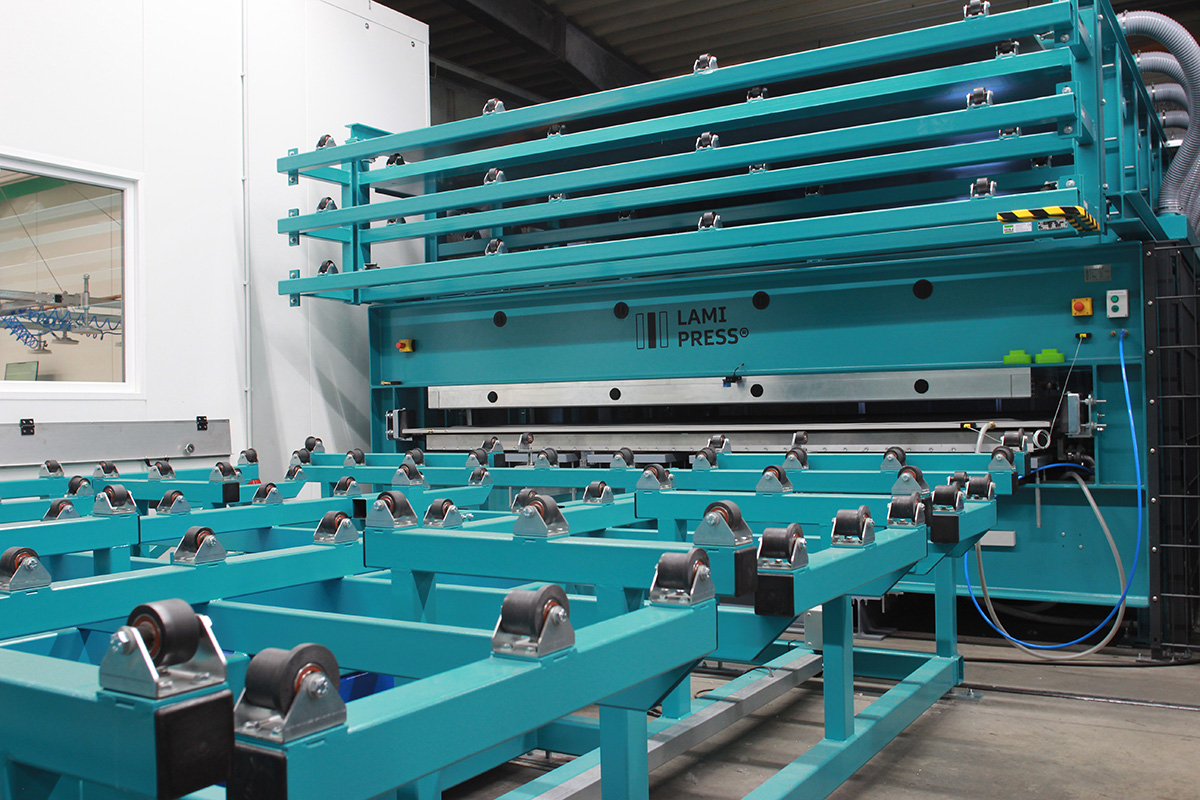
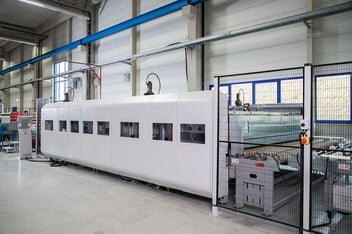
Laminated glass is being used in an ever wider range of applications, while at the same time, requirements for process reliability, flexibility, and cost efficiency continue to rise. LamiPress expands the LiSEC portfolio with an innovative, highly precise, and scalable solution for laminated safety glass production.
Manufacturers of laminated safety glass face the challenge of mapping increasing throughput volumes, varying glass formats, and the highest quality requirements within stable and efficient processes. At the same time, production space is limited, product mixes are variable, and process reliability is critical to avoid waste and achieve predictable cycle times. Many companies therefore require flexible, scalable solutions that match their available floor space, capacity targets, and quality requirements.
This is exactly where LamiPress comes into play—as a technology that combines production reliability, efficiency, and flexibility in a single system and fundamentally rethinks the classic lamination process.
### LamiPress – PROCESS-STABLE TECHNOLOGY FOR LAMINATED GLASS PRODUCTION
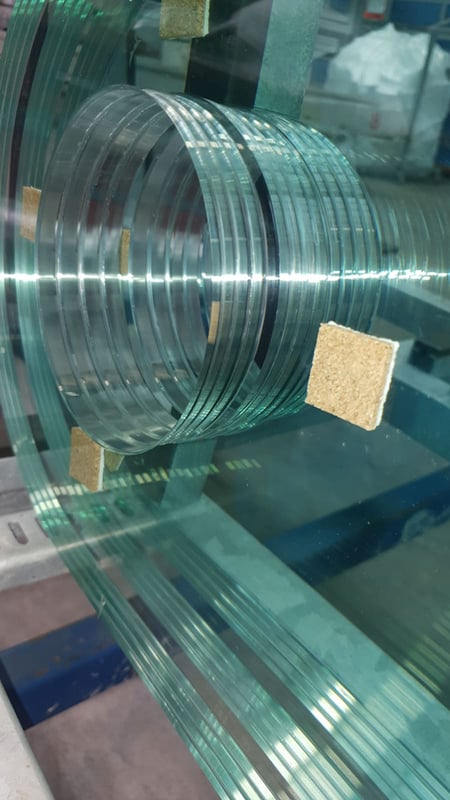The technology is based on a two-stage process consisting of cold vacuum de-airing and a temperature- and overpressure-controlled lamination process. This is supported by a transfer plate logistics system that enables parallel process steps. High reproducibility is achieved through the precisely controlled lamination process within the LamiPress.
##### 1. PREPARATION & COLD VACUUM PRE-LAMINATION
After the glass packages are assembled in the cleanroom, they are positioned on a transfer plate. These are 20 mm thick solid aluminum carrier plates on which the glass packages remain throughout all process steps, ensuring clean and reproducible glass handling.
This is followed by the cold vacuum phase, which typically lasts around 30 minutes. During this step, air inclusions are removed and the glass package is prepared for the subsequent lamination process.
Because this step takes place outside the LamiPress machine, multiple transfer plates can be operated in parallel. While one transfer plate is being loaded in the cleanroom, another is in the cold vacuum station, one is inside the LamiPress, and another is in unloading or post-cooling. After completion of a lamination cycle, the transfer plates rotate one position forward. This principle enables a continuous production flow and significantly improves throughput times.
##### 2. LAMINATION PROCESS IN THE LAMIPRESS
After the cold vacuum phase, the transfer plate is inserted into the LamiPress. The lamination process then takes place, controlled by temperature, vacuum, and overpressure.
Depending on the glass configuration, the average lamination time is approximately 60 minutes. For standard builds such as 2 × 4 mm glass, it is around 45 minutes. Cooling down to handling temperature takes place inside the LamiPress, while final cooling occurs outside the system.
##### 3. UNLOADING & POST-COOLING
After lamination is complete, the transfer plate is removed. The glass cools down completely on the transfer plate before being unloaded and further processed. The direct exchange of transfer plates also allows the use of residual heat from the previous process.
By using multiple transfer plates, preparation, de-airing, lamination, and cooling run simultaneously, enabling a continuous production process.
### THE 5 KEY STRENGTHS OF LAMIPRESS
1. Scrap rate below 1%
Stable and reproducible process control minimizes sources of error and ensures reliable results with every cycle.
2. Precisely scalable system design
LamiPress is tailored to throughput, product mix, and available floor space—delivering an exactly fitting solution instead of a standard size.
3. Maximum flexibility even with a variable product mix
On average, a new batch of finished laminates is available approximately every hour. This allows maximum flexibility with changing product mixes - without loss of productivity..
4. Stable and predictable cycle times
The clear structuring of process phases ensures a consistent and calculable production flow.
5. Flexible layout and system variants
From compact, manual systems to fully automated lines, LamiPress can be integrated into a wide range of production environments and expanded as required.
### LAMIPRESS PRODUCT PORTFOLIO
The LamiPress product portfolio includes modular lamination systems based on a flexible transfer plate logistics concept, configurable for different production sizes, glass formats, and process requirements.
| 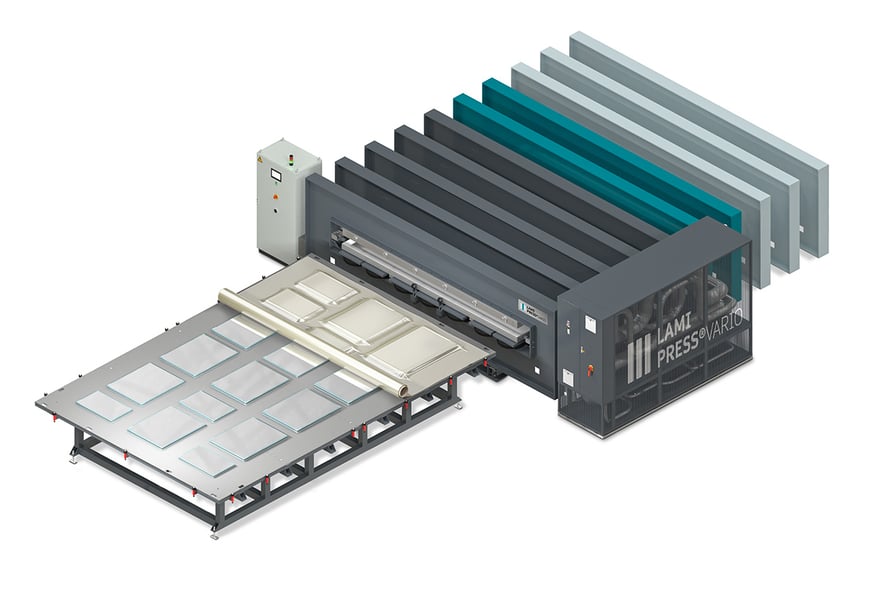 Rendering of the LamiPress base model, automation by LiSEC | 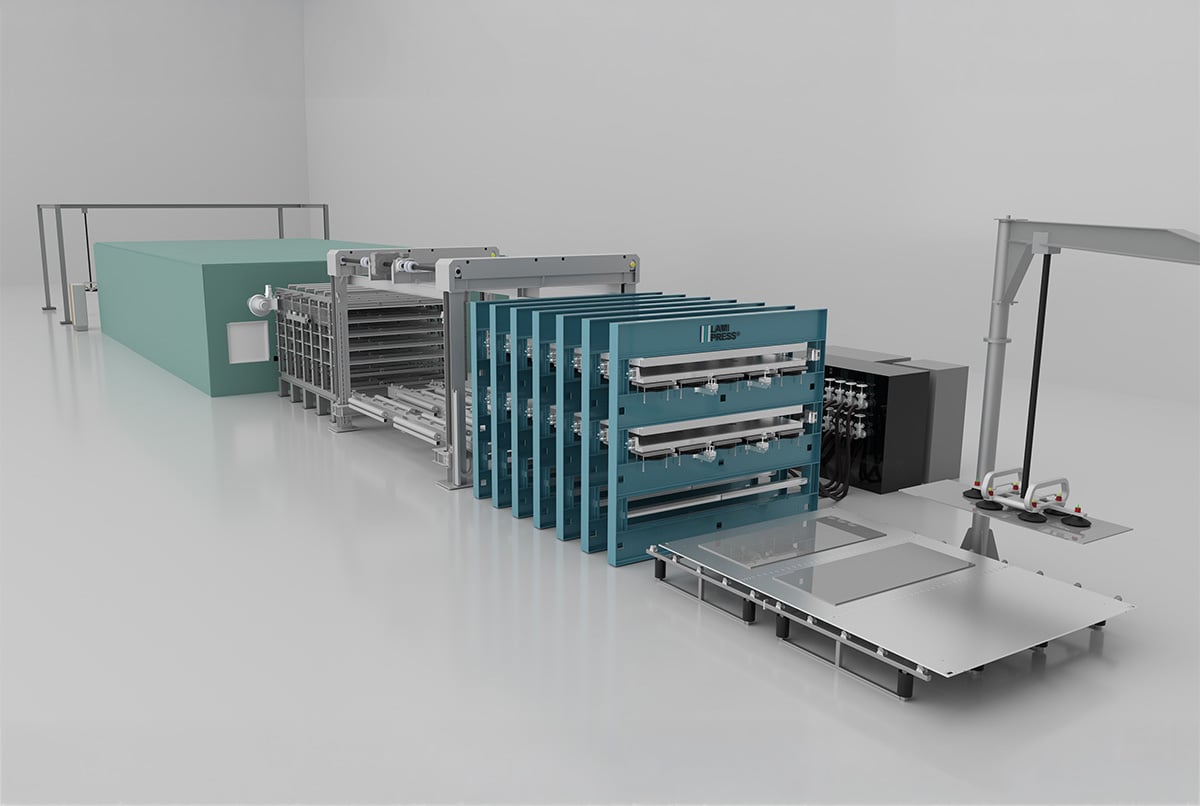 High-output LamiPress configuration without loss of flexibility |
| --- | --- |
The machines are available in multiple variants—from compact base systems to extended configurations. The four expansion levels range from the Basic version through Twin-Table and rotary configurations to the LamiStore solution. With each expansion stage, the number of integrated transfer plates increases, along with the possible throughput.
This allows the system to be precisely matched to the respective product mix, available production space, and desired capacity.
AVAILABILITY
LamiPress is available immediately through the LiSEC sales team. 👉 [https://www.lisec.com/contact](https://www.lisec.com/contact)
Fazit
LamiPress significantly strengthens the LiSEC portfolio in the field of laminated glass production. The solution combines low scrap rates, flexible layout options, and predictable process times with precise, scalable system design for any production environment. At the same time, the technology enables reproducible laminated glass quality at autoclave level, while reducing infrastructure and operating effort. This provides manufacturers with a system that delivers technical stability, high flexibility, and economic efficiency in equal measure.
[](https://www.facebook.com/lisecaustriagmbh/) [](https://at.linkedin.com/company/lisec-austria-gmbh) [](https://twitter.com/lisecgroup) [](mailto:info@lisec.com)
Subscribe
### Subscribe Via Email

##### Leave a comment
### Recommended Posts
[](https://blog.lisec.com/pre-lamination?hsLang=en)
### [Why is pre-lamination the heart of the lamination system?](https://blog.lisec.com/pre-lamination?hsLang=en)
Pre-lamination is often referred to as the heart of a laminating system in the industry. And...
[](https://blog.lisec.com/future-proof-laminated-glass?hsLang=en)
### [Future-Proof Laminated Glass](https://blog.lisec.com/future-proof-laminated-glass?hsLang=en)
Due to its excellent properties such as safety, sound insulation, UV protection and as well as uses...
[](https://blog.lisec.com/lami-basics?hsLang=en)
### [Laminated Glass: Invisible Protection with High-Tech Potential](https://blog.lisec.com/lami-basics?hsLang=en)
Laminated glass plays an important safety role: the combination of glass and interlayer film...
#### I would like to receive information on new LiSEC products and services
Register now
##### About LiSEC
- [Locations & Contact](https://www.lisec.com/about-lisec/locations-contact/)
- [Company](https://www.lisec.com/about-lisec/company/)
- [Purchasing](https://www.lisec.com/about-lisec/purchasing/)
- [Careers](https://www.lisec.com/careers/working-at-lisec/)
- [Glass Forum](https://www.lisec.com/glass-processing/glass-forum/)
- [CE Declaration of Performance](https://www.lisec.com/glass-processing/ce-declaration-of-performance/)
##### Service
- [Training](https://www.lisec.com/service/training/)
- [FAQ](https://www.lisec.com/service/faq/)
- [Testing & Competence Center](https://www.lisec.com/service/training-service-center/)
- [My LiSEC](https://www.lisec.com/service/my-lisec/)
##### News
- [News](https://www.lisec.com/news/news/)
- [Events](https://www.lisec.com/news/events/)
- [Customer Magazine LEAD](https://www.lisec.com/news/customer-magazine-lead/)
- [Downloads](https://www.lisec.com/footer/news/downloads/)
- [Press contact](https://www.lisec.com/news/press-contact/)
##### Follow us
-
-
-
-
- [](https://www.karriere.at/b/lisec-austria#content)
- [](https://x.com/lisecgroup/)
- Copyright © 2023 LiSEC
- [Imprint](https://www.lisec.com/meta/imprint/)
- [Privacy Policy](https://www.lisec.com/meta/privacy-policy/)
- [Cookie Policy](https://www.lisec.com/meta/cookie-policy/)
#### best in glass processing
Settings for cookies and third-party applications
Cookies and third-party applications are used on our website. This helps us to guarantee the best possible performance of our website, especially
- the constant improvement of the functionality of our website (analysis of the user visit),
- a smooth experience when using the website or
- the placement of suitable advertising for users on certain platforms.
Do you consent to the use of cookies and the processing of personal data associated therewith?
Further information
Yes, I agree
Required These cookies ensure the basic functions of our website. This enables preferred settings to be made available to you again when you revisit the website. These include country and language settings. They also help to ensure the safe use of our website.
Functional We can analyse the use of our website using these cookies. They help us to constantly improve the functionality of our website.
Save
You can find more information on the use of cookies and opt-out options in our privacy statement.
You can amend your cookie settings at any time using the cookie settings link in the page footer. Please refer to our extensive [privacy statement](https://blog.lisec.com/meta/privacy-policy/?hsLang=en) for more information.
### LISEC NEWSLETTER SERVICE
[JETZT REGISTRIEREN](https://www.lisec.com/contact/data-verfication/?tx_form_formframework%5Baction%5D=perform&tx_theme_pi3%5Bcontroller%5D=RegistrationForm&cHash=78457fd789ddb12b5b2b33799e53eade)
### Follow us on:
-
-
-
-
-
-
- [](https://www.karriere.at/b/lisec-austria#content)
### ABOUT LISEC
- [Locations & Contact](https://www.lisec.com/about-lisec/contact)
- [Company](https://www.lisec.com/about-lisec/company/)
- [Purchasing](https://www.lisec.com/about-lisec/purchasing/)
- [Careers](https://www.lisec.com/careers/working-at-lisec/)
- [CE Declaration of Performance](https://www.lisec.com/competence/process-development/ce-declaration-of-performance)
### Service
- [Training](https://www.lisec.com/competence/after-sale-service/training/)
- [FAQ](https://www.lisec.com/competence/after-sale-service/faq/)
- [My LiSEC](https://www.lisec.com/competence/after-sale-service/mylisec)
### News & Aktuelles
- [News](https://www.lisec.com/news/news/)
- [Events](https://www.lisec.com/news/news/)
- [Downloads](https://www.lisec.com/footer/news/downloads/)
- [Press Contact](https://www.lisec.com/news/press-contact/)
- COPYRIGHT © 2024 LiSEC
- [IMPRINT](https://www.lisec.com/meta/imprint/)
- [PRIVACY POLICY](https://www.lisec.com/menus/meta/privacy-policy)
- [COOKIE POLICY](https://www.lisec.com/menus/meta/cookie-policy)
- [TRANSPARENCY LINE](https://hub.lisec.com/whistleblowing)
- [COOKIE SETTINGS](https://www.lisec.com/menus/meta/cookie-policy)
all.in.one:solutions
[](https://www.lisec.com/)