---
title: "Efficient glass logistics: How transport and storage work in the flat glass industry"
description: Learn how logistics works in the flat glass industry—from transportation and storage to automation.
image: https://blog.lisec.com/hubfs/vlcsnap-2026-01-13-11h26m24s732_Felbermayer_Glaslager_Kran_web.jpg
---
- [Blog](https://blog.lisec.com/)
- [kontakt](https://www.lisec.com/de/ueber-lisec/kontakt)
- [downloads](https://www.lisec.com/de/43)
- [Hotline & Online Support](https://www.lisec.com/de/kompetenz/after-sale-service/hotline-online-support)
- [SUCCESS STORIES](https://www.lisec.com/de/news/success-stories)
- [](https://www.lisec.com/contact/)
- [](https://business-portal.lisec.com/signin.php)
- 
### WÄHLEN SIE IHRE SPRACHE
- [English](https://blog.lisec.com/de/flat-glass-logistics-1)
- [Deutsch](https://blog.lisec.com/de/flat-glass-logistics)
- [Lösungen](https://www.lisec.com/de/loesungen/individuelle-einzelmaschinen)
- [Individuelle Einzelmaschinen](https://www.lisec.com/de/loesungen/individuelle-einzelmaschinen)
- [Glaszuschnitt](https://www.lisec.com/de/loesungen/individuelle-einzelmaschinen#collapse-34)
- [Isolierglasfertigung](https://www.lisec.com/de/loesungen/individuelle-einzelmaschinen#collapse-35)
- [Logistiksystem](https://www.lisec.com/de/loesungen/individuelle-einzelmaschinen#collapse-44)
- [Flachglasbearbeitung](https://www.lisec.com/de/loesungen/individuelle-einzelmaschinen#collapse-36)
- [Vorspannen](https://www.lisec.com/de/loesungen/individuelle-einzelmaschinen#collapse-37)
- [Schraml - Glasbearbeitung & Waschen](https://www.lisec.com/de/loesungen/individuelle-einzelmaschinen#collapse-1044)
- [Cericom - Laseranlagen](https://www.lisec.com/de/loesungen/individuelle-einzelmaschinen#collapse-1013)
- [Systemlösung/ Linien](https://www.lisec.com/de/loesungen/systemloesungen-linien)
- [Glaszuschnittlinie](https://www.lisec.com/de/loesungen/systemloesungen-linien#collapse-42)
- [Isolierglaslinien](https://www.lisec.com/de/loesungen/systemloesungen-linien#collapse-911)
- [Glasbearbeitungslinie](https://www.lisec.com/de/loesungen/systemloesungen-linien#collapse-43)
- [Verbundglaslinien](https://www.lisec.com/de/loesungen/systemloesungen-linien#collapse-199)
- [Software](https://www.lisec.com/de/loesungen/software/)
- [Software für Business Management](https://www.lisec.com/de/loesungen/software#collapse-82)
- [Software für Production Management](https://www.lisec.com/de/loesungen/software/#collapse-120)
- [Software für Shopfloor Management](https://www.lisec.com/de/loesungen/software/#collapse-123)
- [Software an den Anlagen](https://www.lisec.com/de/loesungen/software/#collapse-124)
- [Gebrauchtmaschinen](https://www.lisec.com/de/loesungen/gebrauchtmaschinen)
- [Kompetenz](https://www.lisec.com/de/kompetenz/after-sale-service/)
- [After Sale / Service](https://www.lisec.com/de/kompetenz/after-sale-service)
- [HOTLINE & ONLINE SUPPORT](https://www.lisec.com/de/kompetenz/after-sale-service/hotline-online-support/)
- [Live Support System - LiSEC.eye](https://www.lisec.com/de/kompetenz/after-sale-service/live-support-system-liseceye/)
- [LiSERV](https://www.lisec.com/de/kompetenz/after-sale-service/liserv/)
- [MyLiSEC](https://www.lisec.com/de/kompetenz/after-sale-service/my-lisec/)
- [Schulungen](https://www.lisec.com/de/kompetenz/after-sale-service/schulungen/)
- [LiSAIR Express Delivery](https://www.lisec.com/de/kompetenz/after-sale-service/ersatzteile/)
- [Ersatzteile](https://www.lisec.com/de/kompetenz/after-sale-service/ersatzteile/)
- [Inspektion und Wartung](https://www.lisec.com/de/kompetenz/after-sale-service/inspektion-und-wartung/)
- [Claim Management](https://www.lisec.com/de/kompetenz/after-sale-service/claim-management)
- [LONGLiFE](https://www.lisec.com/de/kompetenz/after-sale-service/longlife/)
- [FAQ](https://www.lisec.com/de/kompetenz/after-sale-service/faq/)
- [Verfahrensentwicklung](https://www.lisec.com/de/kompetenz/glasverarbeitung/produkte/)
- [Produkte](https://www.lisec.com/de/kompetenz/glasverarbeitung/produkte/)
- [Referenzen](https://www.lisec.com/de/kompetenz/glasverarbeitung/referenzen/)
- [Kontakt](https://www.lisec.com/de/kompetenz/glasverarbeitung/kontakt/glastech-produktions-und-verfahrenstechnik-gmbh/)
- [CE-Leistungserklärungen](https://www.lisec.com/de/kompetenz/glasverarbeitung/ce-leistungserklaerungen/)
- [GLASTECH](https://www.lisec.com/de/kompetenz/glasverarbeitung/glastech/)
- [Glastech Zertifikat](https://www.lisec.com/de/footer/news-aktuelles/downloads/#?category=750&subcategory=751)
- [Karriere](https://www.lisec.com/de/karriere/arbeiten-bei-lisec/)
- [Arbeiten bei LiSEC](https://www.lisec.com/de/karriere/arbeiten-bei-lisec/)
- [Stellenangebote](http://lisec.bewerberportal.at/Jobs)
- [Schüler/Studierende](https://www.lisec.com/de/karriere/schuelerstudierende/)
- [Lehre bei LiSEC](https://www.lisec.com/de/karriere/lehre-bei-lisec/)
- [Schnuppern bei LiSEC](https://www.lisec.com/de/karriere/schnuppern-bei-lisec)
- [Initiativbewerbung](https://lisec.bewerberportal.at/Register?job=57734&culture=de)
- [Karrieremessen](https://www.lisec.com/de/karriere/karrieremessen)
- [Kontakt](https://www.lisec.com/de/karriere/kontakt/oesterreich)
- [News](https://www.lisec.com/de/news/)
- [News](https://www.lisec.com/de/news/news)
- [Success Stories](https://www.lisec.com/de/news/success-stories/)
- [Events](https://www.lisec.com/de/news/events/)
- [Pressekontakt](https://www.lisec.com/de/news/pressekontakt/)
- [Newsletter](https://www.lisec.com/de/news/newsletter)
- [Presseverteiler](https://www.lisec.com/de/news/presseverteiler/)
- [Downloads](https://www.lisec.com/de/footer/news-aktuelles/downloads/)
- [Über LiSEC](https://www.lisec.com/de/ueber-lisec/unternehmen/)
- [Unternehmen](https://www.lisec.com/de/ueber-lisec/unternehmen/)
- [Management](https://www.lisec.com/de/ueber-lisec/management/)
- [Unternehmensgeschichte](https://www.lisec.com/de/ueber-lisec/unternehmensgeschichte/)
- [Einkauf](https://www.lisec.com/de/ueber-lisec/einkauf/)
- [Kontakt](https://www.lisec.com/de/ueber-lisec/kontakt)
[](https://www.lisec.com/)
- [Systemlösungen/ Linien](https://www.lisec.com/de/loesungen/systemloesungen-linien/)
- [Glaszuschnittlinie](https://www.lisec.com/de/loesungen/systemloesungen-linien/#collapse-42)
- [](https://www.lisec.com/de/loesungen/systemloesungen-linien/#collapse-42)
- [Insulating glass line](https://www.lisec.com/de/loesungen/systemloesungen-linien/#collapse-911)
- [](https://www.lisec.com/de/loesungen/systemloesungen-linien/#collapse-911)
- [Glasbearbeitungslinie](https://www.lisec.com/de/loesungen/systemloesungen-linien/#collapse-43)
- [](https://www.lisec.com/de/loesungen/systemloesungen-linien/#collapse-43)
- [Verbundglaslinien](https://www.lisec.com/de/loesungen/systemloesungen-linien/#collapse-199)
- [](https://www.lisec.com/de/loesungen/systemloesungen-linien/#collapse-199)
- [Einzelmaschinen](https://www.lisec.com/de/loesungen/einzelmaschinen/)
- [Glaszuschnitt](https://www.lisec.com/de/loesungen/einzelmaschinen/#collapse-34)
- [](https://www.lisec.com/de/loesungen/einzelmaschinen/#collapse-34)
- [Isolierglasfertigung](https://www.lisec.com/de/loesungen/einzelmaschinen/#collapse-35)
- [](https://www.lisec.com/de/loesungen/einzelmaschinen/#collapse-35)
- [Logistiksystem](https://www.lisec.com/de/loesungen/einzelmaschinen/#collapse-44)
- [](https://www.lisec.com/de/loesungen/einzelmaschinen/#collapse-44)
- [Flachglasbearbeitung](https://www.lisec.com/de/loesungen/einzelmaschinen/#collapse-36)
- [](https://www.lisec.com/de/loesungen/einzelmaschinen/#collapse-36)
- [Glasbearbeitung & Waschen](https://www.lisec.com/de/loesungen/einzelmaschinen/#collapse-219)
- [](https://www.lisec.com/de/loesungen/einzelmaschinen/#collapse-219)
- [Qualitätsmanagement](https://www.lisec.com/de/loesungen/einzelmaschinen/#collapse-46)
- [](https://www.lisec.com/de/loesungen/einzelmaschinen/#collapse-46)
- [Vorspannen](https://www.lisec.com/de/loesungen/einzelmaschinen/#collapse-37)
- [](https://www.lisec.com/de/loesungen/einzelmaschinen/#collapse-37)
- [Success Stories](https://www.lisec.com/de/loesungen/einzelmaschinen/#collapse-209)
- [](https://www.lisec.com/de/loesungen/einzelmaschinen/#collapse-209)
- [base](https://www.lisec.com/de/loesungen/einzelmaschinen/#collapse-38)
- [](https://www.lisec.com/de/loesungen/einzelmaschinen/#collapse-38)
- [Software](https://www.lisec.com/de/loesungen/software/)
- [Software für Business Management](https://www.lisec.com/de/loesungen/software/#collapse-82)
- [](https://www.lisec.com/de/loesungen/software/#collapse-82)
- [Software für Production Management](https://www.lisec.com/de/loesungen/software/#collapse-120)
- [](https://www.lisec.com/de/loesungen/software/#collapse-82)
- [Software für Shopfloor Management](https://www.lisec.com/de/loesungen/software/#collapse-123)
- [](https://www.lisec.com/de/loesungen/software/#collapse-123)
- [Software an den Anlagen](https://www.lisec.com/de/loesungen/software/#collapse-124)
- [](https://www.lisec.com/de/loesungen/software/#collapse-124)
- [Konfigurator](https://www.lisec.com/de/loesungen/konfigurator/)
-
-
-
- [Gebrauchtmaschinen](https://www.lisec.com/de/loesungen/gebrauchtmaschinen/)
-
-
-
- [After Sale / Service](https://www.lisec.com/de/kompetenz/after-sale-service/)
- [HOTLINE & ONLINE SUPPORT](https://www.lisec.com/de/kompetenz/after-sale-service/hotline-online-support/)
-
-
- [LiSEC Process Control](https://www.lisec.com/de/kompetenz/after-sale-service/lisec-process-control/)
-
-
- [Live Support System - LiSEC.eye](https://www.lisec.com/de/kompetenz/after-sale-service/live-support-system-liseceye/)
-
-
- [LiSERV](https://www.lisec.com/de/kompetenz/after-sale-service/liserv/)
-
-
- [My LiSEC](https://www.lisec.com/de/kompetenz/after-sale-service/my-lisec/)
-
-
- [Ersatzteile](https://www.lisec.com/de/kompetenz/after-sale-service/ersatzteile/)
- 
- [LiSAIR Express Delivery](https://www.lisec.com/de/kompetenz/after-sale-service/lisair-express-delivery/)
-
-
- [Kontakte Ersatzteil-Service](https://www.lisec.com/de/kompetenz/after-sale-service/kontakte-ersatzteil-service/)
- 
- [Inspektion und Wartung (STS)](https://www.lisec.com/de/kompetenz/after-sale-service/inspektion-und-wartung-sts/)
-
-
- [Installation (IPM)](https://www.lisec.com/de/kompetenz/after-sale-service/installation-ipm/)
-
-
- [LONGLiFE](https://www.lisec.com/de/kompetenz/after-sale-service/longlife/#?)
-
-
- [Schulungen](https://www.lisec.com/de/kompetenz/after-sale-service/schulungen/)
- 
- [FAQ](https://www.lisec.com/de/kompetenz/after-sale-service/faq/)
- 
- [Glasverarbeitung](https://www.lisec.com/de/kompetenz/glasverarbeitung/produkte/)
- [Produkte](https://www.lisec.com/de/kompetenz/glasverarbeitung/produkte/)
- 
- [Referenzen](https://www.lisec.com/de/kompetenz/glasverarbeitung/referenzen/)
-
-
- [Kontakt](https://www.lisec.com/de/kompetenz/glasverarbeitung/kontakt/glastech-produktions-und-verfahrenstechnik-gmbh/)
- 
- [CE-Leistungserklärungen](https://www.lisec.com/de/kompetenz/glasverarbeitung/ce-leistungserklaerungen/)
- [](https://www.lisec.com/de/kompetenz/glasverarbeitung/ce-leistungserklaerungen/)
- [GLASTECH](https://www.lisec.com/de/kompetenz/glasverarbeitung/glastech/)
-
-
- [Glastech Zertifikat](https://www.lisec.com/de/footer/news-aktuelles/downloads/#?category=750&subcategory=751)
-
-
- [Arbeiten bei LiSEC](https://www.lisec.com/de/karriere/arbeiten-bei-lisec/)
- [Schüler/Studierende](https://www.lisec.com/de/karriere/schuelerstudierende/)
-
-
-
- [Lehre bei LiSEC](https://www.lisec.com/de/karriere/lehre-bei-lisec/)
-
-
-
- [Initiativbewerbung](https://lisec.bewerberportal.at/Register?job=57734&culture=de)
-
-
-
- [Kontakt](https://www.lisec.com/de/karriere/kontakt/oesterreich/)
-
-
-
- [News](https://www.lisec.com/de/news/news/)
- [Success Stories](https://www.lisec.com/de/news/success-stories/)
-
-
-
- [Events](https://www.lisec.com/de/news/events/)
-
-
-
- [LEAD-Kundenmagazin](https://www.lisec.com/de/news/lead-kundenmagazin/)
-
-
-
- [Pressekontakt](https://www.lisec.com/de/news/pressekontakt/)
-
-
-
- [Presseverteiler](https://www.lisec.com/de/news/presseverteiler/)
-
-
-
- [Downloads](https://www.lisec.com/de/footer/news-aktuelles/downloads/)
-
-
-
- [Unternehmen](https://www.lisec.com/de/ueber-lisec/unternehmen/)
- [Management](https://www.lisec.com/de/ueber-lisec/management/)
-
-
-
- [Einkauf](https://www.lisec.com/de/ueber-lisec/einkauf/)
-
-
-
- [Standorte & Ansprechpartner](https://www.lisec.com/de/ueber-lisec/standorte-ansprechpartner/)
-
-
-
- [Unternehmensgeschichte](https://www.lisec.com/de/ueber-lisec/unternehmensgeschichte/)
-
-
-
### Categories
- [Glass Processing (20)](https://blog.lisec.com/tag/glass-processing)
- [Glass Cutting (16)](https://blog.lisec.com/tag/glass-cutting)
- [Laminated Glass Production (16)](https://blog.lisec.com/tag/laminated-glass-production)
- [Insulating Glass Production (12)](https://blog.lisec.com/tag/insulating-glass-production)
- [Glass Logistics (8)](https://blog.lisec.com/tag/glass-logistics)
- [Longlife (7)](https://blog.lisec.com/tag/longlife)
- [Service (6)](https://blog.lisec.com/tag/service)
- [Software (6)](https://blog.lisec.com/tag/software)
- [Podcast (2)](https://blog.lisec.com/tag/podcast)
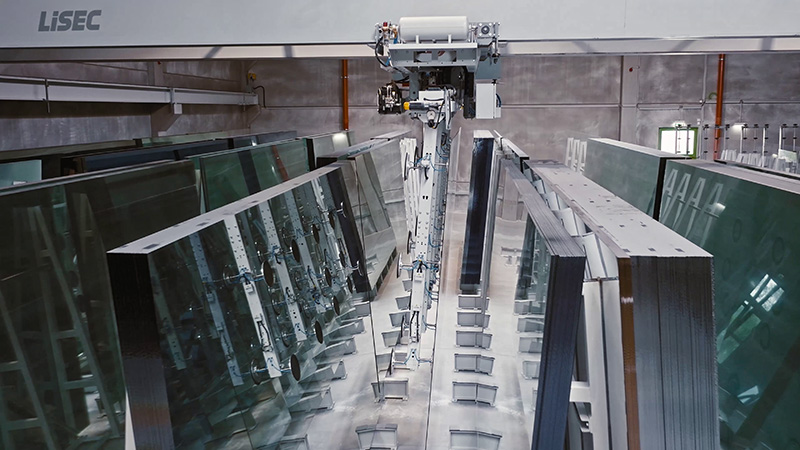
# Efficient glass logistics: How transport and storage work in the flat glass industry
Posted by
Sarah Hummelsberger on Jan 13, 2026, 12:10:13 PM

Large glass formats, high weight, and delicate surfaces place unique demands on logistics in the flat glass industry. From raw glass delivery through internal handling and processing steps to the shipment of finished products, a well-coordinated logistics concept determines the efficiency, cost-effectiveness, and quality of a production site.
### **Raw Glass Transport with Inloader Systems**
Raw glass is typically transported using so-called inloader trucks. These consist of a standard tractor unit and a specially designed trailer. Inside the trailer is an inloader frame on which the glass sheets are transported upright. Common glass sizes are around 6 meters in length and 3.30 meters in height.
For unloading, the truck drives into the flat glass processor’s hall and automatically sets down the entire inloader frame. It then leaves the site, usually taking an empty frame back to the glass producer, where it is reloaded with raw glass. This creates a continuous logistics cycle between glass producer and processor.
#### Why Is Glass Transported Upright?
Vertical transport offers several advantages. First, it allows large glass formats to comply with legal road dimensions. If jumbo sheets were transported horizontally, even the narrower side of 3.30 meters would exceed permissible vehicle widths.
Second, weight is a critical factor. Inloader trucks already carry around 20 tons of glass. Horizontal stacking would increase weight further, requiring special transport solutions with higher costs, greater effort, and additional safety risks. Vertical transport has therefore become the efficient and safe industry standard.
### **Internal Glass Logistics**
Daily raw glass requirements dictate internal logistics and depend heavily on the size and capacity of the plant. Medium-sized processors often handle around 100 tons of glass per day, while large sites with multiple cutting tables, tempering furnaces, and insulating glass lines can process several hundred tons daily. Logistics here go beyond raw glass delivery—intermediate storage, internal transport, and staging of semi-finished products are equally important.
#### Fully Automated Glass Storage
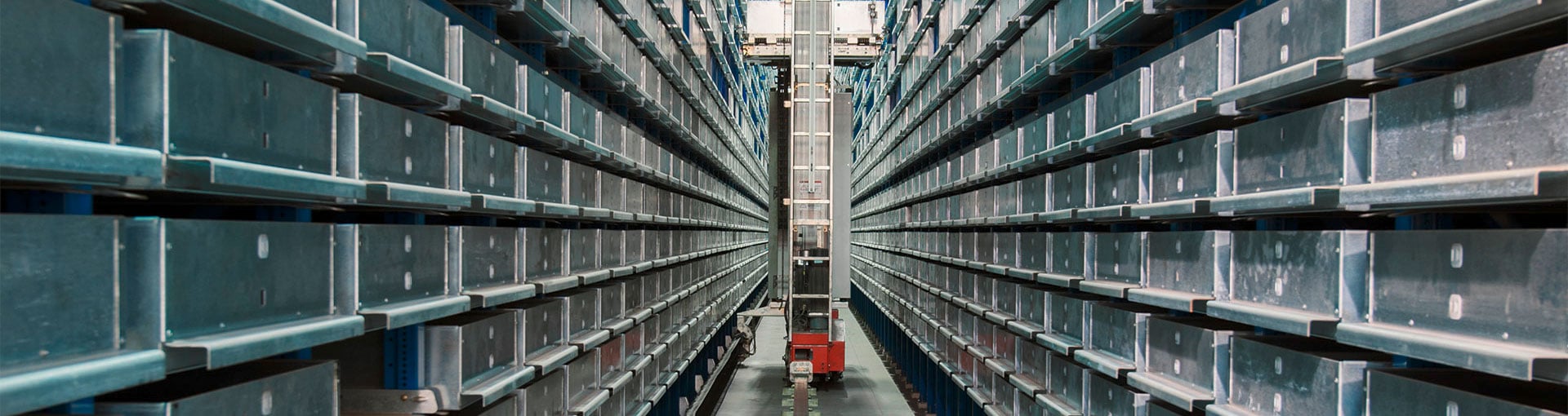
In highly automated plants, raw glass retrieval from storage is fully automated using [crane-based systems with suction lifters](https://www.lisec.com/solutions/systems-lines/detail/logistic-systems/crane-loading). These cranes operate on overhead rails or floor-mounted tracks. The suction frame grips the uncoated side of the glass, separates individual sheets safely, and transports them vertically to a transfer point. Only at this point is the glass tilted horizontally using a controlled tipping station before being passed on—usually to the cutting line.
#### Glass Racks, Storage, and Order Picking
Glass racks—also called “A-frames” or “L-frames”—are central to glass logistics. They serve both for raw glass storage and finished product transport.
- **L-Racks**: Loadable on one side, often placed along walls.
- **A-Racks**: A-shaped, loadable on both sides, ideal for central hall areas.
For high-density storage, [compact systems](https://www.lisec.com/solutions/systems-lines/detail/logistic-systems/slot-rack-system-with-side-loader-removal) are increasingly used. These consist of movable L-racks that slide together accordion-style. When a specific glass type is needed, the corresponding slot is opened, enabling large volumes to be stored in minimal space.
#### **Between Cutting and Further Processing**
Glass sheets pass through numerous steps such as cutting, edge processing, painting, enameling, tempering, laminating, or insulating glass production. Each step requires coordinated transport and buffering systems. After cutting, sheets are either manually or automatically removed and placed on racks. Modern plants use [automated buffer systems](https://www.lisec.com/solutions/systems-lines/detail/logistic-systems/buffer-and-sorting-system-stationary) to temporarily store and route sheets to subsequent processes.
[Production planning](https://www.lisec.com/solutions/software/detail/production-planning/prod) and [logistics software](https://www.lisec.com/solutions/software/detail/logistics/delivery) ensure smooth operations by managing sequencing, buffer utilization, and timely glass availability. In less automated plants, experienced production managers or shift supervisors handle this coordination manually.
**Glass Logistics as an Efficiency Driver**
Glass transport is a complex system where logistics, production planning, manufacturing, and quality assurance must work seamlessly together. With rising production volumes and larger formats, efficient glass logistics is becoming increasingly critical.
Want to learn more about glass logistics? Check out our podcast **LiSTEN LiSEC.**
[](https://www.facebook.com/lisecaustriagmbh/) [](https://at.linkedin.com/company/lisec-austria-gmbh) [](https://twitter.com/lisecgroup) [](mailto:info@lisec.com)
Subscribe
### Subscribe Via Email

##### Leave a comment
### Recommended Posts
[](https://blog.lisec.com/benefit-from-innovations?hsLang=en)
### [How you can benefit from the innovations in glass cutting machines for laminated glass](https://blog.lisec.com/benefit-from-innovations?hsLang=en)
For 25 years LiSEC has been working at the highest international level with machines for cutting...
[](https://blog.lisec.com/storage-of-laminated-glass-affects-cutting?hsLang=en)
### [How the storage of laminated glass affects the glass cutting](https://blog.lisec.com/storage-of-laminated-glass-affects-cutting?hsLang=en)
It is well known that laminated safety glass (LSG) is a material that is specifically processed...
[](https://blog.lisec.com/design-of-the-machine-affects-glass-cutting?hsLang=en)
### [How the design of the machine affects the glass cutting of laminated glass](https://blog.lisec.com/design-of-the-machine-affects-glass-cutting?hsLang=en)
Cutting laminated glass requires a total of three machines, which must be joined together to form...
#### I would like to receive information on new LiSEC products and services
Register now
##### About LiSEC
- [Locations & Contact](https://www.lisec.com/about-lisec/locations-contact/)
- [Company](https://www.lisec.com/about-lisec/company/)
- [Purchasing](https://www.lisec.com/about-lisec/purchasing/)
- [Careers](https://www.lisec.com/careers/working-at-lisec/)
- [Glass Forum](https://www.lisec.com/glass-processing/glass-forum/)
- [CE Declaration of Performance](https://www.lisec.com/glass-processing/ce-declaration-of-performance/)
##### Service
- [Training](https://www.lisec.com/service/training/)
- [FAQ](https://www.lisec.com/service/faq/)
- [Testing & Competence Center](https://www.lisec.com/service/training-service-center/)
- [My LiSEC](https://www.lisec.com/service/my-lisec/)
##### News
- [News](https://www.lisec.com/news/news/)
- [Events](https://www.lisec.com/news/events/)
- [Customer Magazine LEAD](https://www.lisec.com/news/customer-magazine-lead/)
- [Downloads](https://www.lisec.com/footer/news/downloads/)
- [Press contact](https://www.lisec.com/news/press-contact/)
##### Follow us
-
-
-
-
- [](https://www.karriere.at/b/lisec-austria#content)
- [](https://x.com/lisecgroup/)
- Copyright © 2023 LiSEC
- [Imprint](https://www.lisec.com/meta/imprint/)
- [Privacy Policy](https://www.lisec.com/meta/privacy-policy/)
- [Cookie Policy](https://www.lisec.com/meta/cookie-policy/)
#### best in glass processing
Settings for cookies and third-party applications
Cookies and third-party applications are used on our website. This helps us to guarantee the best possible performance of our website, especially
- the constant improvement of the functionality of our website (analysis of the user visit),
- a smooth experience when using the website or
- the placement of suitable advertising for users on certain platforms.
Do you consent to the use of cookies and the processing of personal data associated therewith?
Further information
Yes, I agree
Required These cookies ensure the basic functions of our website. This enables preferred settings to be made available to you again when you revisit the website. These include country and language settings. They also help to ensure the safe use of our website.
Functional We can analyse the use of our website using these cookies. They help us to constantly improve the functionality of our website.
Save
You can find more information on the use of cookies and opt-out options in our privacy statement.
You can amend your cookie settings at any time using the cookie settings link in the page footer. Please refer to our extensive [privacy statement](https://blog.lisec.com/meta/privacy-policy/?hsLang=en) for more information.
### ICH MÖCHTE ÜBER NEUE PRODUKTE UND DIENSTLEISTUNGEN VON LISEC INFORMIERT WERDEN
[JETZT REGISTRIEREN](https://www.lisec.com/de/kontakt/data-verfication/?tx_form_formframework%5Baction%5D=perform&tx_theme_pi3%5Bcontroller%5D=RegistrationForm&cHash=78457fd789ddb12b5b2b33799e53eade)
### FOLGEN SIE UNS
-
-
-
-
-
-
- [](https://www.karriere.at/b/lisec-austria#content)
### Über LiseC
- [Standorte & Ansprechpartner](https://www.lisec.com/de/ueber-lisec/kontakt)
- [Unternehmen](https://www.lisec.com/de/ueber-lisec/unternehmen/)
- [Einkauf](https://www.lisec.com/de/ueber-lisec/einkauf/)
- [Karriere](https://www.lisec.com/de/karriere/arbeiten-bei-lisec/)
- [GLASTECH](https://www.lisec.com/de/kompetenz/verfahrensentwicklung/glastech)
- [CE-Leistungserklärungen](https://www.lisec.com/de/kompetenz/verfahrensentwicklung/ce-leistungserklaerungen)
### Service
- [Schulung](https://www.lisec.com/de/kompetenz/after-sale-service/schulungen/)
- [FAQ](https://www.lisec.com/de/kompetenz/after-sale-service/faq/)
- [LiSERV](https://www.lisec.com/de/kompetenz/after-sale-service/liserv)
- [My LiSEC](https://www.lisec.com/de/kompetenz/after-sale-service/mylisec)
### News & Aktuelles
- [News](https://www.lisec.com/de/news/news/)
- [Events](https://www.lisec.com/de/news/events/)
- [Downloads](https://www.lisec.com/de/footer/news-aktuelles/downloads/)
- [Pressekontakt](https://www.lisec.com/de/news/pressekontakt/)
- [Kundeninformation](https://www.lisec.com/de/footer-registrierung)
- COPYRIGHT © 2024 LiSEC
- [IMPRESSUM](https://www.lisec.com/de/menus/meta/impressum)
- [DATENSCHUTZ](https://www.lisec.com/de/menus/meta/datenschutz)
- [COOKIE POLICY](https://www.lisec.com/de/menus/meta/cookie-policy)
- [TRANSPARENCY LINE](https://hub.lisec.com/de-at/whistleblowing)
- [COOKIE SETTINGS](https://www.lisec.com/cookie-settings)
all.in.one:solutions
[](https://www.lisec.com/)