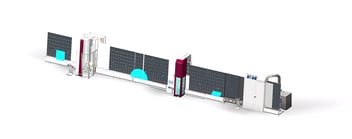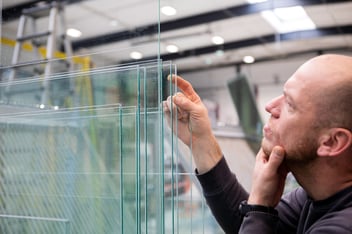













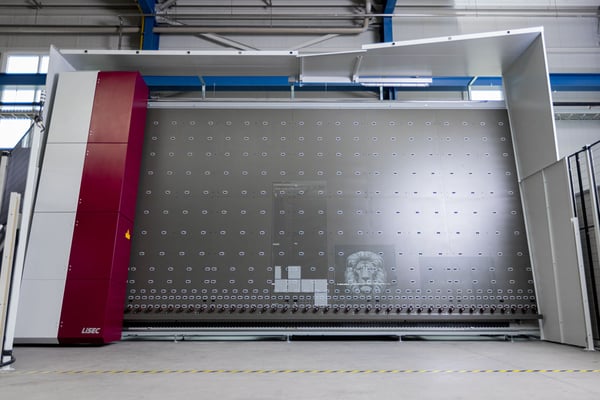
How can glass surfaces be designed while precisely processing functional coatings—without additional materials? The LSP-A combines two laser processes in a single system, opening up new possibilities ranging from bird protection to high-tech glazing.
HOW DOES THE COMBINATION OF ENGRAVING AND DECOATING WORK?
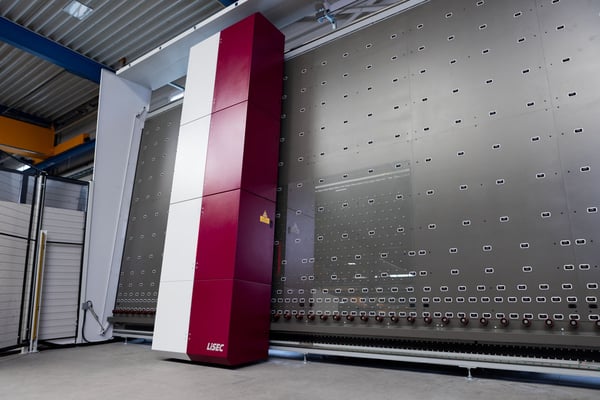
The LSP-A integrates two different laser sources into one system, creating a flexible solution for glass processing. The approach: surface structuring and selective coating removal are carried out in a continuous process—without additives or consumables.
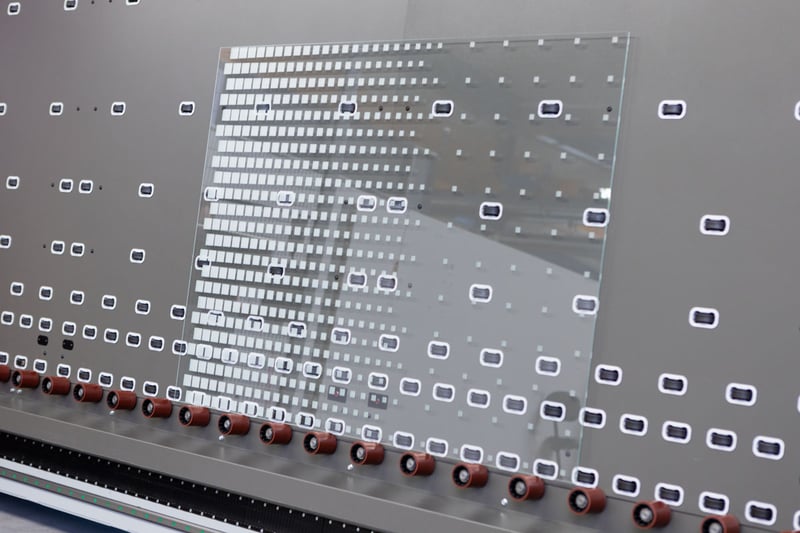
CO₂ LASER FOR STRUCTURE AND VISIBILITY
The first process is based on a CO₂ laser acting directly on the glass surface. Depending on the settings, minimal material removal creates matte or engraved structures with clearly visible contrasts.
Typical applications:
- Bird protection glass: Dot-shaped structures in a defined grid pattern make glass surfaces visible to birds and reduce collisions
- Decorative glass: Logos, lettering, or designs can be applied directly to the glass
- Slip-resistant surfaces: Dense structures enable certified slip resistance (e.g. R9 and R10)
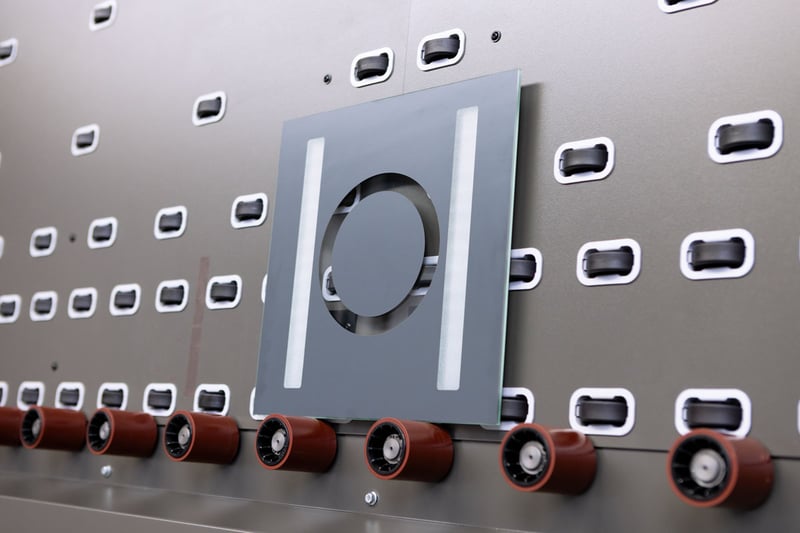
NIR LASER FOR PRECISE COATING REMOVAL
WHAT DISTINGUISHES THE LSP-A IN OPERATION?
The second laser source—a near-infrared (NIR) laser—is used for the selective removal of functional coatings without affecting the glass itself.
This opens up possibilities that are difficult to achieve using mechanical processes:
-
Finest structures: Grids with widths of only around 20 µm
-
Retention of function: As only a small portion of the coating is removed, its functionality is preserved
New applications:
-
Transmission for mobile communication signals
-
Preparation for heated glass
-
Precise mirror decoating without matting the glass
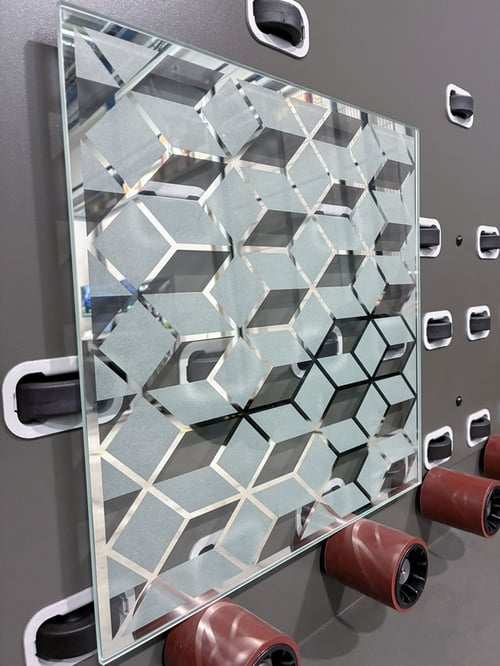 WHAT DISTINGUISHES THE LSP-A IN OPERATION?
A key advantage lies in the combination of both processes in one system—enhanced by high efficiency and flexibility.
Key highlights at a glance:
-
Combination of engraving and decoating in one system
-
Processing without additives or consumables
-
High productivity, e.g. up to 55–60 m²/h for bird protection glass
-
Two CO₂ lasers operating simultaneously for parallel processing
-
Flexible integration—possible before or after tempering
-
Use as a standalone machine or fully automated in lines (e.g. as a bypass)
-
Laser safety class 1—no additional protective measures required
-
Energy-efficient design
Thanks to these characteristics, the LSP-A can be used in a wide range of production environments—from façade construction to interior applications such as design glass or functional mirrors.
AVAILABILITY AND FURTHER INFORMATION
From 20–23 October 2026, you can see the LSP-A live at the LiSEC booth, Hall 17 / A64 in Düsseldorf.
The LSP-A can be flexibly integrated into existing production lines or used as a stand-alone solution. Further information and personal consultation: 👉 https://www.lisec.com/about-lisec/contact
Summary
The combination of two laser processes in one system significantly expands the possibilities of glass processing. The LSP-A enables both functional and design applications—efficiently, flexibly, and without additional materials.





.jpg?width=352&name=beitragsbild1-allgemein-beitrag4-glass-polishing-edge-processing-lisec.2022%20(1).jpg)