---
title: "Triple IGUs with Thin Glass: New Opportunities in Renovation Projects"
description: Discover how thin glass in triple insulating glass enhances energy efficiency in renovations, minimizing structural changes while maximizing performance.
image: https://blog.lisec.com/hubfs/Duennglas_200526_0060_bearbeitet_web.jpg
---
- [BLOG](https://blog.lisec.com/)
- [CONTACT](https://www.lisec.com/about-lisec/contact)
- [DOWNLOADS](https://www.lisec.com/news/downloads)
- [Hotline & ONLINESUPPORT](https://www.lisec.com/competence/after-sale-service/hotline-online-support)
- [SUCCESS STORIES](https://www.lisec.com/news/success-stories-1)
- [](https://www.lisec.com/contact/)
- [](https://business-portal.lisec.com/signin.php)
- 
### CHOOSE YOUR LANGUAGE
- [English](https://blog.lisec.com/thin-glas)
- [Deutsch](https://blog.lisec.com/de/thin-glas)
- SOLUTIONS
- Systems & Lines
- [Glass Cutting Line](https://www.lisec.com/solutions/systems-lines#collapse-42)
- [Insulating glass line](https://www.lisec.com/solutions/systems-lines#collapse-911)
- [Glass Processing Line](https://www.lisec.com/solutions/systems-lines#collapse-43)
- [Laminated Glass Line](https://www.lisec.com/solutions/systems-lines#collapse-199)
- [Individual Machines](https://www.lisec.com/solutions/individual-machines)
- [Glass Cutting](https://www.lisec.com/solutions/individual-machines#collapse-34)
- [Insulating Glass Production](https://www.lisec.com/solutions/individual-machines#collapse-34)
- [Sorting & Logistics Systems](https://www.lisec.com/solutions/individual-machines#collapse-44)
- [Flat Glass Processing](https://www.lisec.com/solutions/individual-machines#collapse-36)
- [Glass Processing & Wash](https://www.lisec.com/solutions/individual-machines#collapse-219)
- [Quality management](https://www.lisec.com/solutions/individual-machines#collapse-46)
- [Tempering](https://www.lisec.com/solutions/individual-machines#collapse-46)
- [base](https://www.lisec.com/solutions/individual-machines#collapse-38)
- [Success Stories](https://www.lisec.com/solutions/individual-machines#collapse-209)
- [Software](https://www.lisec.com/solutions/software)
- [Software for Business Management](https://www.lisec.com/solutions/software/#collapse-82)
- [Software for Production Management](https://www.lisec.com/solutions/software/#collapse-120)
- [Software for Shopfloor Management](https://www.lisec.com/solutions/software/#collapse-123)
- [Software on machines](https://www.lisec.com/solutions/software/#collapse-124)
- [Preowned machines](https://www.lisec.com/solutions/preowned-machines/)
- COMPETENCE
- [AFTER SALES / SERVICES](https://www.lisec.com/competence/after-sale-service/)
- [HOTLiNE & ONLiNE SUPPORT](https://www.lisec.com/competence/after-sale-service/hotline-online-support/)
- [LiSEC Process Control](https://www.lisec.com/competence/after-sale-service/lisec-process-control/)
- [Live Support System - LiSEC.eye](https://www.lisec.com/competence/after-sale-service/live-support-system-liseceye/)
- [LiSERV](https://www.lisec.com/competence/after-sale-service/liserv/)
- [My LiSEC](https://www.lisec.com/competence/after-sale-service/my-lisec/)
- [Spare Parts](https://www.lisec.com/competence/after-sale-service/spare-parts/)
- [LiSAIR Express Delivery](https://www.lisec.com/competence/after-sale-service/lisair-express-delivery/)
- [Contacts spare parts service](https://www.lisec.com/competence/after-sale-service/contacts-spare-parts-service/)
- [Inspection and Maintenance](https://www.lisec.com/competence/after-sale-service/inspection-and-maintenance/)
- [Installation](https://www.lisec.com/competence/after-sale-service/installation/)
- [LONGLiFE](https://www.lisec.com/competence/after-sale-service/longlife/)
- [Training](https://www.lisec.com/competence/after-sale-service/training/)
- [FAQ](https://www.lisec.com/competence/after-sale-service/faq/)
- [PROCESS DEVELOPMENT](https://www.lisec.com/competence/process-development/products)
- [Products](https://www.lisec.com/competence/process-development/products)
- [References](https://www.lisec.com/competence/process-development/references#?)
- [Contact](https://www.lisec.com/competence/process-development/contact/glastech-produktions-und-verfahrenstechnik-gmbh)
- [CE Declaration of Performance](https://www.lisec.com/competence/process-development/contact/glastech-produktions-und-verfahrenstechnik-gmbh)
- [GLASTECH](https://www.lisec.com/competence/process-development/glastech)
- [GLASTECH CERTIFICATE](https://www.lisec.com/footer/news/downloads/#?category=750&subcategory=751)
- [SPACER](https://www.lisec.com/footer/news/downloads/#?category=750&subcategory=751)
- [PRODUCTS](https://www.lisec.com/competence/spacer/products)
- CAREERS
- [Working At LiSEC](https://www.lisec.com/careers/working-at-lisec)
- [Apprenticship At LiSEC](https://www.lisec.com/careers/apprenticeship-at-lisec)
- [A Day At LiSEC](https://www.lisec.com/careers/a-day-at-lisec)
- [Online Application](https://lisec.bewerberportal.at/Jobs)
- [Carrer Fairs](https://www.lisec.com/careers/career-fairs)
- [Contact](https://www.lisec.com/careers/contact/austria/)
- NEWS
- [News](https://www.lisec.com/news/news)
- [Success Stories](https://www.lisec.com/news/success-stories-1)
- [Events](https://www.lisec.com/news/events/)
- [Press Contact](https://www.lisec.com/news/press-contact/)
- [Press Distributor](https://www.lisec.com/news/press-distributor/)
- [Downloads](https://www.lisec.com/footer/news/downloads/)
- ABOUT LISEC
- [Company](https://www.lisec.com/about-lisec/company/)
- [Management](https://www.lisec.com/about-lisec/management/)
- [History](https://www.lisec.com/about-lisec/history/)
- [Purchasing](https://www.lisec.com/about-lisec/purchasing)
- [Contact](https://www.lisec.com/about-lisec/contact)
[](https://www.lisec.com/)
- [Systems & Lines](https://www.lisec.com/de/loesungen/systemloesungen-linien/)
- [Glass Cutting Line](https://www.lisec.com/solutions/systems-lines/#collapse-42)
- [](https://www.lisec.com/solutions/systems-lines/#collapse-42)
- [Insulating glass line](https://www.lisec.com/solutions/systems-lines/#collapse-911)
- [](https://www.lisec.com/solutions/systems-lines/#collapse-911)
- [Glass Processing Line](https://www.lisec.com/solutions/systems-lines/#collapse-43)
- [](https://www.lisec.com/solutions/systems-lines/#collapse-43)
- [Laminated Glass Line](https://www.lisec.com/solutions/systems-lines/#collapse-199)
- 
- [Individual Machines](https://www.lisec.com/solutions/individual-machines)
- [Glass Cutting](https://www.lisec.com/solutions/individual-machines#collapse-34)
- [](https://www.lisec.com/solutions/stand-alone-machines/#collapse-34)
- [Insulating Glass Production](https://www.lisec.com/solutions/individual-machines#collapse-34)
- [](https://www.lisec.com/solutions/stand-alone-machines/#collapse-34)
- [Sorting & Logistics Systems](https://www.lisec.com/solutions/individual-machines#collapse-44)
- [](https://www.lisec.com/solutions/stand-alone-machines/#collapse-44)
- [Flat Glass Processing](https://www.lisec.com/solutions/individual-machines#collapse-36)
- [](https://www.lisec.com/solutions/stand-alone-machines/#collapse-36)
- [Glass Processing & Wash](https://www.lisec.com/solutions/individual-machines#collapse-219)
- [](https://www.lisec.com/solutions/stand-alone-machines/#collapse-219)
- [Quality management](https://www.lisec.com/solutions/individual-machines#collapse-46)
- [](https://www.lisec.com/solutions/stand-alone-machines/#collapse-46)
- [Tempering](https://www.lisec.com/solutions/individual-machines#collapse-46)
- [](https://www.lisec.com/solutions/stand-alone-machines/#collapse-46)
- [base](https://www.lisec.com/solutions/individual-machines#collapse-38)
- [](https://www.lisec.com/solutions/stand-alone-machines/#collapse-38)
- [Success Stories](https://www.lisec.com/solutions/individual-machines#collapse-209)
- [](https://www.lisec.com/solutions/stand-alone-machines/#collapse-209)
- [Software](https://www.lisec.com/solutions/software/)
- [Software for Business Management](https://www.lisec.com/solutions/software/#collapse-82)
- [](https://www.lisec.com/solutions/software/#collapse-82)
- [Software for Production Management](https://www.lisec.com/solutions/software/#collapse-120)
- [](https://www.lisec.com/solutions/software/#collapse-120)
- [Software for Shopfloor Management](https://www.lisec.com/solutions/software/#collapse-123)
- [](https://www.lisec.com/solutions/software/#collapse-123)
- [Software on machines](https://www.lisec.com/solutions/software/#collapse-124)
- [](https://www.lisec.com/solutions/software/#collapse-124)
- [Configurator](https://www.lisec.com/solutions/configurator/)
-
-
-
- [Preowned machines](https://www.lisec.com/solutions/preowned-machines/)
-
-
-
- [After Sale / Service](https://www.lisec.com/competence/after-sale-service/)
- [HOTLiNE & ONLiNE SUPPORT](https://www.lisec.com/competence/after-sale-service/hotline-online-support/)
- [](https://www.lisec.com/competence/after-sale-service/hotline-online-support/)
- [LiSEC Process Control](https://www.lisec.com/competence/after-sale-service/lisec-process-control/)
- [](https://www.lisec.com/competence/after-sale-service/lisec-process-control/)
- [Live Support System - LiSEC.eye](https://www.lisec.com/competence/after-sale-service/live-support-system-liseceye/)
- [](https://www.lisec.com/competence/after-sale-service/live-support-system-liseceye/)
- [LiSERV](https://www.lisec.com/competence/after-sale-service/liserv/)
- [](https://www.lisec.com/competence/after-sale-service/liserv/)
- [My LiSEC](https://www.lisec.com/competence/after-sale-service/my-lisec/)
- [](https://www.lisec.com/competence/after-sale-service/my-lisec/)
- [Spare Parts](https://www.lisec.com/competence/after-sale-service/spare-parts/)
- [](https://www.lisec.com/competence/after-sale-service/spare-parts/)
- [LiSAIR Express Delivery](https://www.lisec.com/competence/after-sale-service/lisair-express-delivery/)
- [](https://www.lisec.com/competence/after-sale-service/lisair-express-delivery/)
- [Contacts spare parts service](https://www.lisec.com/competence/after-sale-service/contacts-spare-parts-service/)
- [](https://www.lisec.com/competence/after-sale-service/contacts-spare-parts-service/)
- [Inspection and Maintenance](https://www.lisec.com/competence/after-sale-service/inspection-and-maintenance/)
- [](https://www.lisec.com/competence/after-sale-service/inspection-and-maintenance/)
- [Installation](https://www.lisec.com/competence/after-sale-service/installation/)
- [](https://www.lisec.com/competence/after-sale-service/installation/)
- [LONGLiFE](https://www.lisec.com/competence/after-sale-service/longlife/)
- [](https://www.lisec.com/competence/after-sale-service/longlife/)
- [Training](https://www.lisec.com/competence/after-sale-service/training/)
- 
- [FAQ](https://www.lisec.com/competence/after-sale-service/faq/)
- [](https://www.lisec.com/competence/after-sale-service/faq/)
- [Glass Processing](https://www.lisec.com/competence/glass-processing/products/)
- [Product](https://www.lisec.com/competence/glass-processing/products/)
- [](https://www.lisec.com/competence/glass-processing/products/)
- [References](https://www.lisec.com/competence/glass-processing/references/)
- [](https://www.lisec.com/competence/glass-processing/references/)
- [Contact](https://www.lisec.com/competence/glass-processing/contact/glastech-produktions-und-verfahrenstechnik-gmbh/)
- [](https://www.lisec.com/competence/glass-processing/contact/glastech-produktions-und-verfahrenstechnik-gmbh/)
- [CE Declaration of Performance](https://www.lisec.com/competence/glass-processing/ce-declaration-of-performance/)
- [](https://www.lisec.com/competence/glass-processing/ce-declaration-of-performance/)
- [GLASTECH](https://www.lisec.com/competence/glass-processing/glastech/)
- [](https://www.lisec.com/competence/glass-processing/glastech/)
- [Glastech Certificate](https://www.lisec.com/footer/news/downloads/#?category=750&subcategory=751)
-
-
- [SPACER](https://www.lisec.com/competence/spacer/products/)
- [PRODUCTS](https://www.lisec.com/competence/spacer/products/)
- [](https://www.lisec.com/competence/spacer/products/)
- [Working at LiSEC](https://www.lisec.com/careers/working-at-lisec/)
- [Online Application](https://lisec.bewerberportal.at/Register?culture=en)
-
-
-
- [Contact](https://www.lisec.com/careers/contact/austria/)
-
-
-
- [News](https://www.lisec.com/news/news/)
- [Success Stories](https://www.lisec.com/news/success-stories/)
-
-
-
- [Events](https://www.lisec.com/news/events/)
-
-
-
- [Customer Magazine LEAD](https://www.lisec.com/news/customer-magazine-lead/)
-
-
-
- [Press Contact](https://www.lisec.com/news/press-contact/)
-
-
-
- [Press Distributor](https://www.lisec.com/news/press-distributor/)
-
-
-
- [Downloads](https://www.lisec.com/footer/news/downloads/)
-
-
-
- [Company](https://www.lisec.com/about-lisec/company/)
- [Management](https://www.lisec.com/about-lisec/management/)
-
-
-
- [Purchasing](https://www.lisec.com/about-lisec/purchasing/)
-
-
-
- [Locations & Contact](https://www.lisec.com/about-lisec/locations-contact/)
-
-
-
- [History](https://www.lisec.com/about-lisec/history/)
-
-
-
### Categories
- [Glass Processing (20)](https://blog.lisec.com/tag/glass-processing)
- [Glass Cutting (16)](https://blog.lisec.com/tag/glass-cutting)
- [Laminated Glass Production (16)](https://blog.lisec.com/tag/laminated-glass-production)
- [Insulating Glass Production (13)](https://blog.lisec.com/tag/insulating-glass-production)
- [Glass Logistics (8)](https://blog.lisec.com/tag/glass-logistics)
- [Longlife (7)](https://blog.lisec.com/tag/longlife)
- [Service (6)](https://blog.lisec.com/tag/service)
- [Software (6)](https://blog.lisec.com/tag/software)
- [Podcast (2)](https://blog.lisec.com/tag/podcast)
# Triple IGUs with Thin Glass: New Opportunities in Renovation Projects
Posted by
Sarah Hummelsberger on Aug 13, 2026, 9:18:23 AM

When existing windows need to become more energy-efficient, conventional solutions often reach their limits. Triple insulating glass with thin glass enables an improvement of thermal and acousting insulation values with minimal intervention while maintaining high performance.
## HOW THIN GLASS CREATES NEW OPPORTUNITIES IN Triple IGUs
Requirements for energy efficiency are continuously increasing, while existing buildings often offer little scope for structural modifications. Particularly with existing window frames, large glazing areas, or listed buildings, replacing complete systems is often complex, not economically viable or even prohibited.
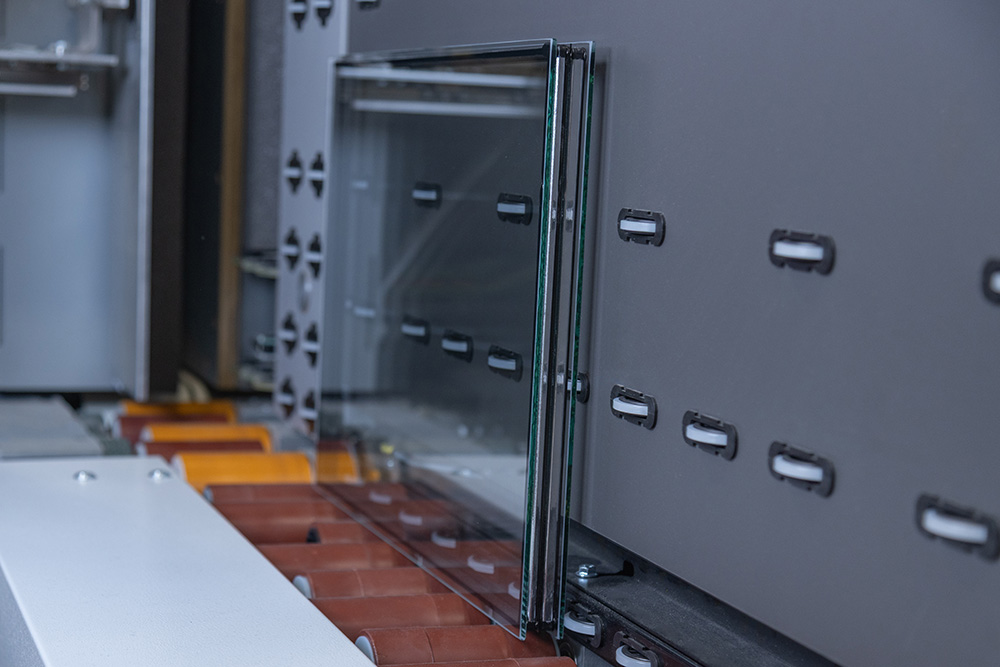
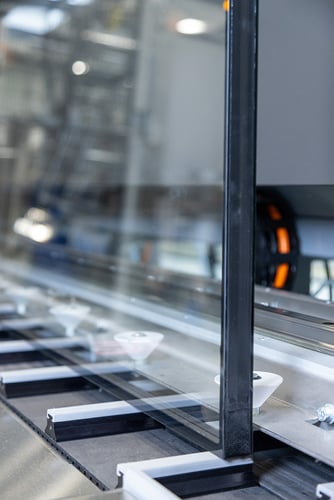
The use of thin glass in triple insulating glass offers a practical alternative. Especially when upgrading existing window frames originally designed for 2-pane insulating glass, the available installation depth is limited. By using 1 mm thin glass instead of a conventional 4 mm centre pane, 3 mm of overall unit thickness can be saved. This gained installation depth can be utilised for wider pane gaps. Larger pane gaps improve thermal insulation and enable favourable Ug values despite a compact design. As a result, a high-performance triple insulating glass unit can be integrated into existing frames without requiring modifications to the frame construction.
Thin glass therefore combines several advantages: lower weight, reduced unit thickness, and high energy efficiency – particularly in renovation projects where existing frames are intended to remain in use.
### KEY ADVANTAGES OF THIN GLASS TECHNOLOGY
One major advantage lies in its ease of implementation: in many cases, simply replacing the existing glazing is sufficient. This results in less intervention in the building structure – an argument that is becoming increasingly important in both residential construction and sensitive projects.
- **Minimal intervention:** In many cases, only the glass needs to be replaced
- **Cost efficiency:** Reduced effort compared with a complete replacement
- **Preservation of the building's character:** Existing components remain in place
- **Energy efficiency:** Improved thermal performance without structural modifications
TYPICAL APPLICATIONS
- Renovation of existing buildings
- Applications in heritage conservation
- Residential construction with large glazed areas
- Replacement of glass in existing windows without frame replacement
### SELECTING THE RIGHT THIN GLASS
Not all thin glass is the same. In addition to thin standard glass (soda-lime glass) with thicknesses down to 1 mm, even thinner boron aluminosilicate glass products with thicknesses of approximately 0.5 mm are available on the market. Due to its special glass composition and manufacturing process, boron aluminosilicate glass offers very high strength even without tempering. One disadvantage is the handling of glass waste during production and recycling at the end of its service life. Strict separation of the different glass types is essential to enable reintroduction into the recycling loop.
The use of thin glass made from conventional soda-lime glass allows joint recycling together with the two outer panes and helps improve resource efficiency. It should be noted that, in this variant, tempering of the glass may be required. Local, country-specific building regulations and standards must be observed.
## CHALLENGES IN THE PRODUCTION OF Triple IG WITH THIN GLASS
The integration of thin glass into triple insulating glass units places increased demands on the entire production process. While the fundamental structure of a triple IGU remains unchanged, the reduced glass thickness affects nearly all processing steps.
In triple insulating glass, thin glass is generally used as the centre pane and manufactured in smaller dimensions than the two outer panes. This centre pane must be slightly lifted (similar to the production of 4-sided stepped units) to ensure that the edge of the centre pane is completely embedded in the edge seal and is no longer visible after production. This design protects the thin glass from mechanical stresses in the edge area and ensures the long-term functional reliability of the insulating glass unit.
### 1. HANDLING AND TRANSPORT
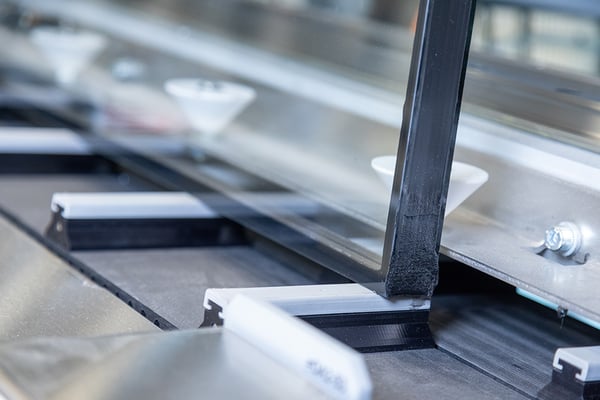
Thin glass is significantly more sensitive to mechanical stress than standard glass. Adapted handling procedures are therefore required already in internal logistics:
- Reduced contact forces on **grippers and transport elements**
- Optimised **acceleration and deceleration** profiles
- Minimisation of micro-deformations and **vibrations**
- Prevention of **edge damage**
Challenge: Due to its lower stiffness, glass panes can bend more easily. This requires more precise process control and, where necessary, adapted support and guiding systems.
### 2. WASHING AND CLEANING PROCESS
Material thickness also plays a decisive role during washing:
- Fine adjustment of **brush pressure** and brush **hardness**
- Adapted **drying parameters** to prevent distortion or uncontrolled movement of the pane
- Ensuring consistent **surface quality**
Challenge: Excessive mechanical pressure can cause surface damage or stress, while insufficient cleaning can impair the quality of subsequent bonding.
### 3. SPACER AND ASSEMBLY PROCESS
Additional requirements arise when assembling the insulating glass unit:
- **Precise positioning** of the panes despite reduced inherent rigidity
- **Accurate alignment** of the spacers
- Ensuring **consistent spacing** between panes
**Challenge:** Thin glass exhibits higher flexibility, increasing the risk of deformation during spacer application. This must be prevented through controlled process parameters.
### 4. GAS FILLING AND SEALING
Hermetic sealing is a critical quality factor:
- Uniform and **precisely positioned application** of primary and secondary sealants
- Prevention of **local stresses** within the edge seal
- **Encapsulation** of the thin centre pane within the secondary sealant
Challenge: Due to the altered structural behaviour of the unit, thin-glass constructions are more sensitive to thermal loads and stresses within the edge seal. The use of suitable thin glass and a clean, repeatable sealing process are therefore essential.
5. QUALITY CONTROL AND PROCESS STABILITY
The combination of reduced thickness and high end-quality requirements makes continuous quality monitoring essential:
- **Optical inspection** for deformations and surface defects
- Verification of **geometry and parallelism**
- **Long-term stability** of the insulating glass unit
## AVAILABILITY & FURTHER INFORMATION
The processing of triple insulating glass with thin glass is part of modern insulating glass solutions and is continuously being further developed. LiSEC also offers corresponding solutions in this field. For project-specific requirements or technical details, further information and contacts are available:
👉 [https://www.lisec.com/contact](https://www.lisec.com/contact)
**Summary**
Triple insulating glass with thin glass opens up new possibilities for renovation projects. Although technically demanding in processing, it provides clear advantages in practical application. The decisive factor is the precise coordination of all process steps to ensure stable and sustainable quality.
[](https://www.facebook.com/lisecaustriagmbh/) [](https://at.linkedin.com/company/lisec-austria-gmbh) [](https://twitter.com/lisecgroup) [](mailto:info@lisec.com)
Subscribe
### Subscribe Via Email

##### Leave a comment
### Recommended Posts
[-1.jpg?width=352&name=beitragsbild1-allgemein-beitrag4-glass-polishing-edge-processing-lisec.2022%20(1)-1.jpg)](https://blog.lisec.com/top-surface-quality-vertical-glass-edge-polishing?hsLang=en)
### [Top surface quality thanks to vertical glass edge polishing](https://blog.lisec.com/top-surface-quality-vertical-glass-edge-polishing?hsLang=en)
Polishing glass edges is the most sensitive task in glass edge processing because it largely...
[](https://blog.lisec.com/professional-seaming-of-glass-edges?hsLang=en)
### [How you enjoy major advantages with the professional seaming of glass edges](https://blog.lisec.com/professional-seaming-of-glass-edges?hsLang=en)
In glass edge processing, cutting the glass sheet is directly followed by the seaming process....
[](https://blog.lisec.com/glass_cutting_basics?hsLang=en)
### [Professional glass cutting: A practical guide](https://blog.lisec.com/glass_cutting_basics?hsLang=en)
How is glass actually cut professionally? From the basics of cutting to the differences between...
#### I would like to receive information on new LiSEC products and services
Register now
##### About LiSEC
- [Locations & Contact](https://www.lisec.com/about-lisec/locations-contact/)
- [Company](https://www.lisec.com/about-lisec/company/)
- [Purchasing](https://www.lisec.com/about-lisec/purchasing/)
- [Careers](https://www.lisec.com/careers/working-at-lisec/)
- [Glass Forum](https://www.lisec.com/glass-processing/glass-forum/)
- [CE Declaration of Performance](https://www.lisec.com/glass-processing/ce-declaration-of-performance/)
##### Service
- [Training](https://www.lisec.com/service/training/)
- [FAQ](https://www.lisec.com/service/faq/)
- [Testing & Competence Center](https://www.lisec.com/service/training-service-center/)
- [My LiSEC](https://www.lisec.com/service/my-lisec/)
##### News
- [News](https://www.lisec.com/news/news/)
- [Events](https://www.lisec.com/news/events/)
- [Customer Magazine LEAD](https://www.lisec.com/news/customer-magazine-lead/)
- [Downloads](https://www.lisec.com/footer/news/downloads/)
- [Press contact](https://www.lisec.com/news/press-contact/)
##### Follow us
-
-
-
-
- [](https://www.karriere.at/b/lisec-austria#content)
- [](https://x.com/lisecgroup/)
- Copyright © 2023 LiSEC
- [Imprint](https://www.lisec.com/meta/imprint/)
- [Privacy Policy](https://www.lisec.com/meta/privacy-policy/)
- [Cookie Policy](https://www.lisec.com/meta/cookie-policy/)
#### best in glass processing
Settings for cookies and third-party applications
Cookies and third-party applications are used on our website. This helps us to guarantee the best possible performance of our website, especially
- the constant improvement of the functionality of our website (analysis of the user visit),
- a smooth experience when using the website or
- the placement of suitable advertising for users on certain platforms.
Do you consent to the use of cookies and the processing of personal data associated therewith?
Further information
Yes, I agree
Required These cookies ensure the basic functions of our website. This enables preferred settings to be made available to you again when you revisit the website. These include country and language settings. They also help to ensure the safe use of our website.
Functional We can analyse the use of our website using these cookies. They help us to constantly improve the functionality of our website.
Save
You can find more information on the use of cookies and opt-out options in our privacy statement.
You can amend your cookie settings at any time using the cookie settings link in the page footer. Please refer to our extensive [privacy statement](https://blog.lisec.com/meta/privacy-policy/?hsLang=en) for more information.
### LISEC NEWSLETTER SERVICE
[JETZT REGISTRIEREN](https://www.lisec.com/contact/data-verfication/?tx_form_formframework%5Baction%5D=perform&tx_theme_pi3%5Bcontroller%5D=RegistrationForm&cHash=78457fd789ddb12b5b2b33799e53eade)
### Follow us on:
-
-
-
-
-
-
- [](https://www.karriere.at/b/lisec-austria#content)
### ABOUT LISEC
- [Locations & Contact](https://www.lisec.com/about-lisec/contact)
- [Company](https://www.lisec.com/about-lisec/company/)
- [Purchasing](https://www.lisec.com/about-lisec/purchasing/)
- [Careers](https://www.lisec.com/careers/working-at-lisec/)
- [CE Declaration of Performance](https://www.lisec.com/competence/process-development/ce-declaration-of-performance)
### Service
- [Training](https://www.lisec.com/competence/after-sale-service/training/)
- [FAQ](https://www.lisec.com/competence/after-sale-service/faq/)
- [My LiSEC](https://www.lisec.com/competence/after-sale-service/mylisec)
### News & Aktuelles
- [News](https://www.lisec.com/news/news/)
- [Events](https://www.lisec.com/news/news/)
- [Downloads](https://www.lisec.com/footer/news/downloads/)
- [Press Contact](https://www.lisec.com/news/press-contact/)
- COPYRIGHT © 2024 LiSEC
- [IMPRINT](https://www.lisec.com/meta/imprint/)
- [PRIVACY POLICY](https://www.lisec.com/menus/meta/privacy-policy)
- [COOKIE POLICY](https://www.lisec.com/menus/meta/cookie-policy)
- [TRANSPARENCY LINE](https://hub.lisec.com/whistleblowing)
- [COOKIE SETTINGS](https://www.lisec.com/menus/meta/cookie-policy)
all.in.one:solutions
[](https://www.lisec.com/)